
Rush County Multi-Day Arrest Reports
Start with the Rushville Recorder RCSO archive. Reports there run across many dates in 2025 and 2026. A single article may group Rush County bookings spread over a week or more. That makes it a workable blotter. It is not a fixed weekly feed. Each entry typically prints a name and a booking date. Charges and a bond figure round it out. Credits often read "RCSO, Provided." Booking photos don't appear in every article. Remember, the Recorder is a newspaper, not the jail. Its archive can't confirm whether anyone remains locked up in Rush County.
The Recorder News archive offers a wider view of how arrest reports sit among the paper's other local coverage. The Recorder news section displays that running list of county stories.
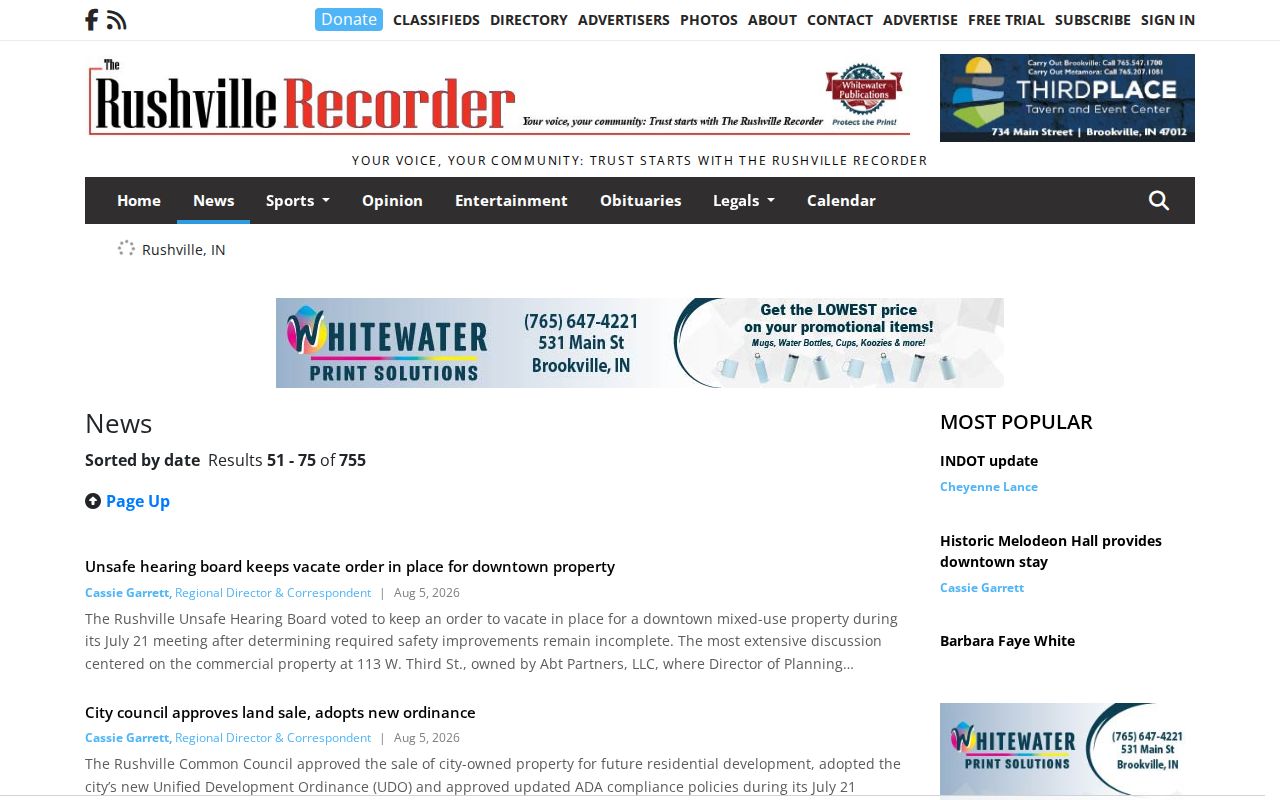
That list frames the coverage, nothing more. Turn to the live article or official Rush County records for current detail.
Read Rush County Blotter Dates
Read blotter dates with two clocks in mind. One is the publication date, when the newspaper posted the story. The other is each booking date, the day the jail actually logged the arrest. These can sit far apart. Never lift a headline date as the arrest date. Open the entry and read it first.
- Open the RCSO author archive and select the newest relevant Arrest Report.
- Note the article’s publication date before reviewing individual entries.
- For each possible match, record the listed booking date, exact charge wording, and bond status.
- Check adjacent reports because one article may cover a span and later articles may include earlier dates.
- Use Rush County JailTracker for present custody and MyCase for the later court path.
Bond entries vary. Some show a dollar figure. Others show a code like NOB or NA. Copy the source wording as printed. Don't turn an abbreviation into a legal meaning the source never defines. Bond is just a release condition. Sometimes you need a fresh Rush County booking, not an old one. The Rush County 24 Hour Arrests page maps out the current-roster route. The arrest log covers a wider window and doesn't update in real time.
Note: Label booking date and article date separately whenever both are available, because the Recorder’s periodic reports can combine several intake dates.
Rush County Arrest Entry Fields
A Recorder report is a short news record. It won't carry every field the Rush County Jail keeps in its custody file or the courts hold in a case. Read only what the article prints. And never stitch details from different dates or people into one invented record.
| Published field | How to interpret it |
|---|---|
| Inmate name | The identity label in the report; confirm namesakes with official identifiers. |
| Booking date | The listed jail intake date, not automatically the arrest, article, or court filing date. |
| Charge or charges | Charges reported from booking, subject to later amendment or dismissal. |
| Bond | An amount or non-dollar notation as supplied; it does not measure guilt. |
| Publication date | The newspaper posting date and a separate point from the booking event. |
| RCSO credit | An indication that content was supplied or authored by the Sheriff’s Office, not proof that every arrest was made by one agency. |
| Photo | Not consistently present in article text; no image should be assumed. |
A jail record in Rush County can hold far more than the public sees. Booking, jacket, and arrest numbers often appear there. So does the facility, the arresting agency, charge codes, status, and custody data. The Recorder entry open to the public is thinner than that internal document, so treat it as a starting point rather than the full arrest record. Anything past booking belongs to the courts. Court dates, cause numbers, and dispositions live on the judicial side, reachable through Indiana MyCase or the Clerk. Charges listed at booking may be abbreviated or revised later, which is one more reason to confirm details against those official case records.
RCSO Reports Cover Rush County
The Recorder labels its RCSO-authored items clearly, and credits like "RCSO, Provided" appear often. These are Rush County reports, not a Rushville Police daily log. An entry might involve Rushville, Carthage, a rural stretch, or someone held for another agency. No reliable city-only filter exists in the archive. That structure matters here. Rushville runs its own police department, while the Sheriff operates the county jail and files countywide material. Carthage posts no separate public town blotter. When a source lists the arresting agency, trust that over a guess drawn from a town name or mailing address. The archive is also selective. It shows what got published, not every Rush County arrest in a period. JailTracker answers who's in custody now. The Sheriff's file answers the official record request. MyCase answers the court question. Each channel does its own job.
- Blotter
- A periodic public list or report about police activity or bookings.
- Booking date
- The date jail intake was recorded.
- Publication date
- The date a newspaper placed the report online.
- Disposition
- The court’s final recorded outcome.
Rush County Weekend Publication Gaps
Neither the Recorder nor the Rush County Sheriff commits to a weekend or holiday publishing schedule. Date clusters show a periodic rhythm. A quiet archive date doesn't prove a day with no arrests. Intake, agency review, handoff to the paper, and publication can each land on a different day. When a report shows up after a gap, check the booking date on every entry. One article can stretch back across prior days. Then scan the neighboring reports. A later post sometimes holds an older arrest. That beats treating each article as a tidy daily batch.
Need current custody fast? Use the JailTracker roster or call the Sheriff at 765-932-2931. For an arrest outside the online span, request the source record. Don't fill newspaper gaps with guesses.
Unofficial Rush County Log Sources
Start with the strong sources for Rush County arrest information. JailTracker shows who is in custody right now. The Sheriff holds the source records. The Recorder posts RCSO reports from time to time. MyCase tracks court developments. Commercial repost sites sit a rung below those. Their data can lag or duplicate a booking. It can drop context, or stay online after an arrest record changes status.
RecentlyBooked's Rush County section presents a rolling recent-arrest set. The site says it refreshes several times a day and keeps about a 30-day window. Those are its own practices, not a Rush County promise. Detail pages may add charges and booking photographs. It cannot settle a custody question or a case outcome. The unofficial rolling Rush County page displays that rolling list directly.
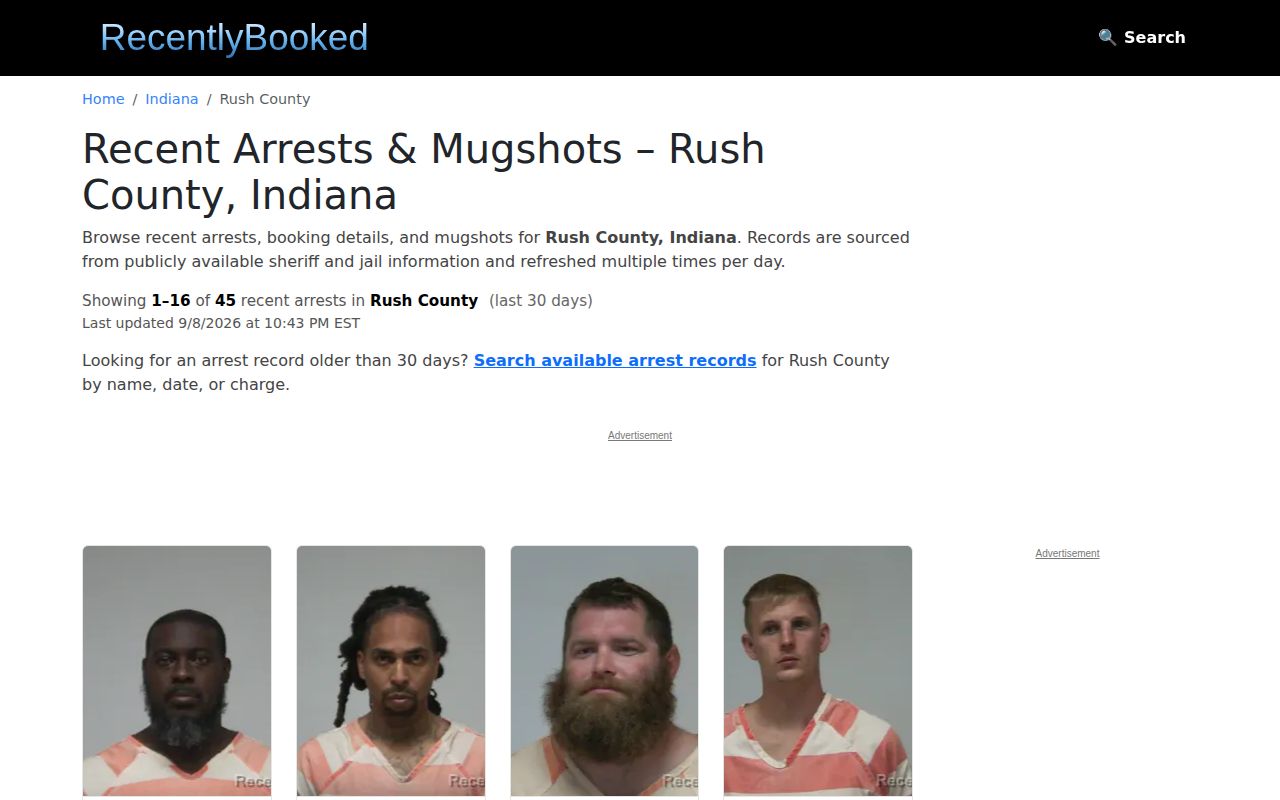
BustedNewspaper's Rush County section works as a secondary channel, not an official roster. Older listings there can carry booking date, agency, charge, bond, and photo fields. The data may sit stale for a long time. Mugshots.com offers only a sparse county section. Arrests.org gives a statewide interface with no stable Rush County landing page. Mugshots.zone leaves Rush County off its Indiana menu.
Regional news adds another angle. Outlets like WRTV's Rush County topic page cover selected incidents. That is journalism, though, not an arrest log. An article tells you about one event and nothing more.
Request Older Rush County Records
An arrest record can vanish from view long before the county destroys the file. Indiana's Public Safety Agencies Retention Schedule defines the adult inmate custody file. It covers intake, booking, transfer, release, and arrest cards. Related legal records sit in the same series. Series PSA 17-39 sets destruction at ten years after incarceration ends. PSA 17-40 covers someone arrested under 18. It uses the later of two dates: ten years after incarceration ends or seven years after the person turns 18.
That schedule governs the custody file, not the web. It promises neither ten years of online access nor ongoing photo display. The vendor roster can change far sooner. Police reports and case files may follow other series entirely. Ask Rush County which schedule it applied rather than assuming one period covers every record.
- Write to the Rush County Sheriff or records custodian at 131 East First Street, Rushville, IN 46173.
- Name the person, approximate booking date, and specific record sought.
- Ask whether the custody file still exists and which retention series applies.
- If transferred, request the accession or new custodial location.
- Call 765-932-2931 to confirm routing, delivery options, and any cost.
If the office mentions an archival transfer, follow that lead. A Rush County Jail booking file does not head to the State Archives by default. Historic IDOC prison records are separate. They form a state correctional collection. Newspaper history is worth exploring through the Indiana State Library's Rush County guide and holdings. A clipping still is not the Sheriff's source record.
Note: The custody-file schedule supports an archival request, but it does not guarantee that a booking photograph remains online or available in every case.
Rush County Arrests Need Court Context
A multi-day arrest report freezes one moment in time. It cannot capture a later amendment, plea, or dismissal. So trace the public court trail next. Match the name and birthdate with care. If the online case leaves questions open, contact the Rush County Clerk. Keep the source date and agency label with anything you save. That habit keeps an old report from being read as a fresh Rush County arrest.