
Tracking Rush County Recent Arrests
One vendor system anchors the county's public custody view. The Rush County Sheriff's Office runs the jail, and a hosted JailTracker roster puts the current in-custody list online. The sheriff publishes no separate 24-hour feed. There is no weekly booking list either. So the roster answers one question well: who appears to be held now. It is not a date-range arrest log. A fresh booking can take time to post, and a released person drops from view. The Rushville Recorder adds another angle by printing arrest reports supplied by the Sheriff's Office on a periodic schedule. An article's publication date often runs later than the booking dates printed inside it, so treat the two sources as separate windows rather than stitching them into a fake live feed.
| Window | Source | Best use | Limit |
|---|---|---|---|
| Same day | JailTracker current roster | Checking present county custody | No fixed refresh time or official 24-hour archive |
| Several days | Rushville Recorder RCSO reports | Reading dated booking summaries | Publication can lag booking and does not prove current custody |
| After filing | Indiana MyCase and Rush County Clerk | Following hearings and disposition | Booking charges can change in court |
The 24 Hour Arrests guide covers the same-day workaround. The Arrest Log page walks through the newspaper record and archive route.
Search the Rush County Jail Roster
The public screen is labeled "Roster" and runs on Public Safety Cloud for Rush County Jail. The Sheriff stays the responsible agency. Behind the scenes, the system tracks identity, intake, agency, charge, and bond fields, though any of them can be hidden or reconfigured in the public display. An image field exists in the vendor setup. That does not promise a booking photo on every entry.
| Search or result field | What it can show |
|---|---|
| First and last name | A possible match that still needs spelling and namesake checks |
| Current-inmate filter | People represented as presently held |
| Booking, jacket, or arrest number | A stronger identifier for a records request |
| Facility and arresting agency | Jail location and the office associated with the arrest |
| Charges and status | Charges entered at booking, not court findings |
| Bond or fine | A recorded release condition or status, subject to change |
| Image | A photo only when the live public configuration exposes it |
Open the roster and search the full name first. Don't stop at the first match. Compare identifiers to confirm you have the right person. Record the booking number, agency, charge wording, and the time you observed it. MyCase then tracks the court trail, or the Sheriff can supply the underlying document. A blank result proves nothing. A fresh booking can lag before posting, and released entries disappear from view. The Rush County Sheriff's Office app handles safety news, tips, and reporting. It promises no booking roster. Use JailTracker for custody questions and the app only for the outreach features it documents.
For urgent release, transfer, or bond details, call the Rush County Sheriff's Office directly. A roster that changes by the hour can lag behind reality.
Rush County Arrest Records Stay Distributed
Rush County's current Sheriff's Office and Jail opened in 2020. It is a 139-bed, 54,630-square-foot building described in the vendor's project description. That newer facility explains the confusion. It is why old address books and directory listings disagree with today's county details. It does not merge the records. The jail roster, the Sheriff's custody file, the court case, and the newspaper report still live apart. Each has a separate custodian serving a separate purpose. So match the system to the custody stage. JailTracker covers the current county view. The Sheriff confirms and releases an existing jail or arrest document. MyCase and the Rush County Clerk carry the public court trail. A later IDOC commitment belongs to the state offender system. Never infer where someone is held from building trivia. The split also explains conflicting dates in a search. Intake happens at the jail before the vendor display updates. A Recorder report may publish days later. Court filings follow their own clock. Keep the source name, the date observed, and the record identifier attached to each fact.
Where Rush County Arrests Appear
Each channel serves a different stage of the process. Check county custody and court outcomes through official systems first. Local news may keep older material alive, while commercial pages can be incomplete, duplicated, or stale.
| Channel | Photo? | Status | Use |
|---|---|---|---|
| Rush County JailTracker | Check the live display | Official-facing roster | Current county custody |
| Rush County Sheriff | Possible through a lawful request | Official agency | Custody, warrants, or a defined record |
| Indiana MyCase | No booking-photo function | Official court system | Case events and disposition |
| Rushville Recorder | Varies by article | Independent news; reports credited to RCSO | Delayed local arrest reports |
| Commercial pages | Often | Unofficial | Discovery only, followed by source verification |
The Recorder news archive shows arrest reports among other local stories.
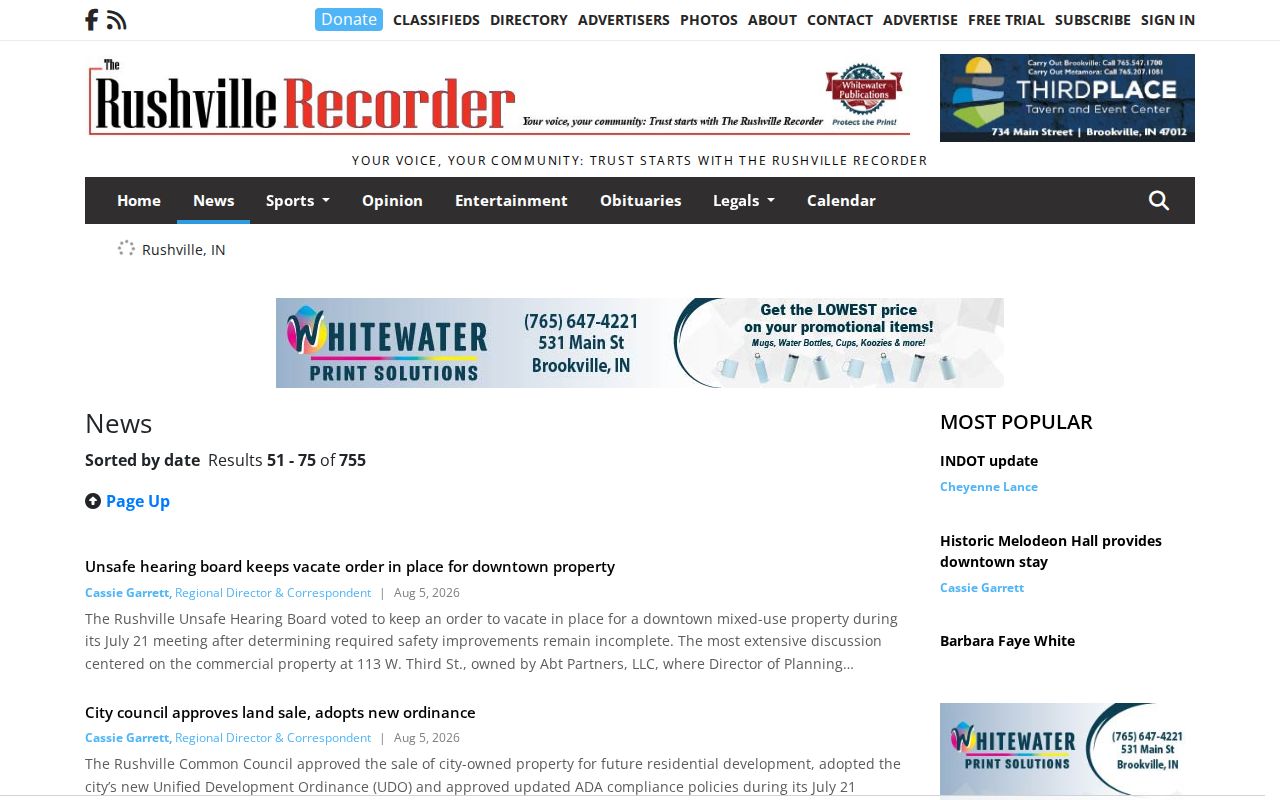
The Rushville Recorder page itself is a periodic news archive. It is not a Sheriff-run live booking feed. Several commercial sites also carry Rush County or Indiana arrest pages. The list includes RecentlyBooked, BustedNewspaper, Mugshots.com, Arrests.org, and Mugshots.zone. Their coverage runs the gamut. Some claim a recent window. Others hold sparse historical material or no Rush-specific section at all. None of them are linked here because an aggregator is never the record custodian. Verify any claim against the Sheriff, the jail, or the court.
Recent Arrests by Rush County City
The county's 2020 Census place table lists two incorporated places. Rushville has its own police department. City arrestees can still be booked at Rush County Jail. The county roster matters even for city arrests. Carthage publishes no town roster or police blotter. Countywide sources are the practical path there.
- Rushville Recent Arrests covers the city police records form, county booking destination, and local reports.
- Carthage Recent Arrests explains the Sheriff-led path and why no town-specific feed is promised.
A location named in a news article is not automatically the arresting agency. When the source record lists an agency field, use that instead.
Reading a Rush County Arrest Record
A booking record freezes the facts entered at intake. The roster, the newspaper report, the Sheriff file, and the court case remain distinct records. Preserve each source's own date and wording rather than merging them into one combined profile.
| Field | Meaning and limit |
|---|---|
| Name | The identity label entered at booking; aliases and namesakes may require more detail |
| Booking date | When intake was recorded, which can differ from arrest or article date |
| Booking or jacket number | An internal identifier useful for a precise request |
| Arresting agency | The office tied to the arrest, not necessarily the jail operator |
| Charge | An charge that may be amended, reduced, or dismissed |
| Bond | A release condition, amount, or non-dollar status, not a measure of guilt |
| Photo | An intake identification image when displayed or released |
| Court data | Cause number, hearings, and disposition found mainly through the court |
Booking means jail intake. Bond is a release condition. Arraignment is an early hearing, disposition is the outcome, and expungement is a court process under Indiana law.
Rush County Mugshots and Booking Photos
Rush County keeps no separate online mugshot gallery. The JailTracker roster is the live custody tool. A photo may or may not attach to a given entry. Look at the listing itself. People who are released or transferred can drop off the roster. The arrest record still sits in county files.
State custody works differently. The Indiana Department of Correction Offender Locator will take a last name, first name, or DOC number. It often shows an offender photograph. It covers state inmates, though, not the Rush County Jail. Think of it as a later stop on the record trail.
The IDOC search screen shows the fields used. They apply once a person has entered the state system.
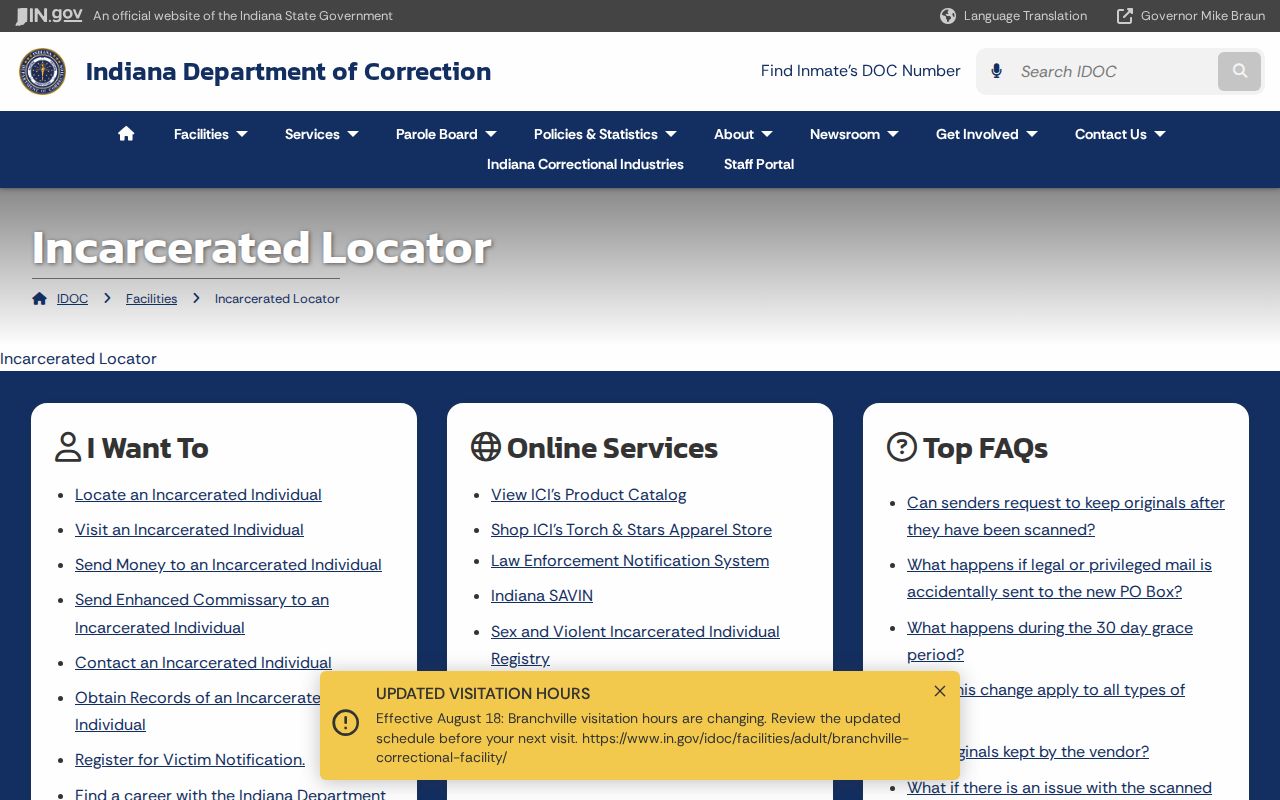
That state search is a later step, not a substitute for the Rush County Jail roster.
A booking photo marks one intake entry in an arrest record. Custody status can shift after the image exists.
Request a Rush County Arrest Record
When a roster entry vanishes, go to the paper trail. Mail a narrow written request to the Rush County Sheriff's Office at 131 East First Street, Rushville, IN 46173. The office publishes no booking-photo form, records email, or fee schedule of its own. Call 765-932-2931 first. Confirm the custodian, the delivery method, and the current copy cost before anything goes in the mail.
- Identify the person, approximate arrest or booking date, arresting agency, and any known booking number.
- Name the exact item, such as a booking record, arrest card, or booking photograph, rather than asking for broad research.
- Ask for an electronic copy when available and a cost estimate before copies are made.
- Keep the request and response. If material is withheld, ask for the legal basis.
- Use Indiana Public Access Counselor guidance when the response raises an APRA question.
Indiana sets response clocks by how a request arrives. Ask in person or by phone, and the office generally acknowledges within 24 hours. Mail, fax, or email a request. The window stretches to seven calendar days. An acknowledgment is not the record itself. The office still needs reasonable time to locate, review, and redact what applies.
No Indiana statute guarantees release of every booking photo. Corrections start with the agency that created the record. When a private publisher offers a documented correction process, that route is open too. Sealing or expungement rides on the case and a court order, nothing else.
Rush County Booking Photo Costs
The Sheriff's page lists no fee schedule aimed at booking photographs. It posts no fixed production timetable either. Treat that silence carefully. It is not a promise that a photo is free, instant, or always open to inspection. Indiana APRA frames the request. The record itself, its format, any exemptions, and the agency's own processing shape the answer.
Ask about the current charge before copies run. Say whether an electronic copy would do, and pin down the booking as tightly as you can. Ask which delivery options the office supports. A strong request names the person. Give the approximate arrest date, the arresting agency if known, and any booking or jacket number. Pulling the photo out from the rest of the booking file also helps the custodian zero in.
Indiana law has no statewide publish-or-remove rule for photographs. Images sit inside the broad public-record definition. Yet investigatory discretion, juvenile limits, court confidentiality, sealing, and expungement can each close the door. The Public Access Counselor's guidance does not force universal release. If the Sheriff withholds or redacts an item, request the legal basis. File the response with your paperwork.
Note: Confirm the fee and delivery method with Rush County before ordering because no Sheriff-specific booking-photo price list was located.
Indiana Arrest Records and Retention
Indiana Code 5-14-3 defines public records broadly. Photographs fit inside that definition. Access still bends to law-enforcement exemptions, investigatory discretion, juvenile protections, confidential details, sealing, and expungement. The Public Access Counselor's mugshot advisory walks through this balance. It never promises that every Rush County photo will come out.
Law in context: APRA controls access and agency response, while Indiana Code 35-38-9 governs expungement. Each law does its own job.
Public-safety records answer to state and local retention schedules. IARA lists retention entries for jail admission and discharge records, inmate files, booking cards, and related custody material. Each class of record keeps its own clock. Transfer or destruction follows the applicable schedule. Older state correctional files can end up in the Indiana Archives.
Juvenile, sealed, expunged, victim, medical, investigative, and confidential material stays out of a general roster. A missing item may be restricted, archived, or removed after release. It may simply sit outside a portal built for current custody. For older stretches of Rush County history, the Indiana State Library's county guide opens a separate door. Its newspaper holdings help when modern portals run dry.
Rush County Arrest Warrants and Wanted Notices
Rush County keeps no standing online warrant list. There is no regular most-wanted page either. Wanted information instead tends to surface through short-lived channels. A Sheriff's appeal on social media, an app notice, or a local news story can carry the names. One local report relayed a Rush County Sheriff appeal for four people said to have active warrants. That story proves a notice can circulate. It proves nothing more. An old article cannot confirm a warrant is still active today, and it shows no posting schedule either. For current status, call the Rush County Sheriff's Office or ask an attorney to verify with the issuing court. Never confront anyone named in a wanted notice. Report any safety concern to law enforcement instead. For court context, the Indiana MyCase search is the official public entry point, though it is not a complete warrant database.
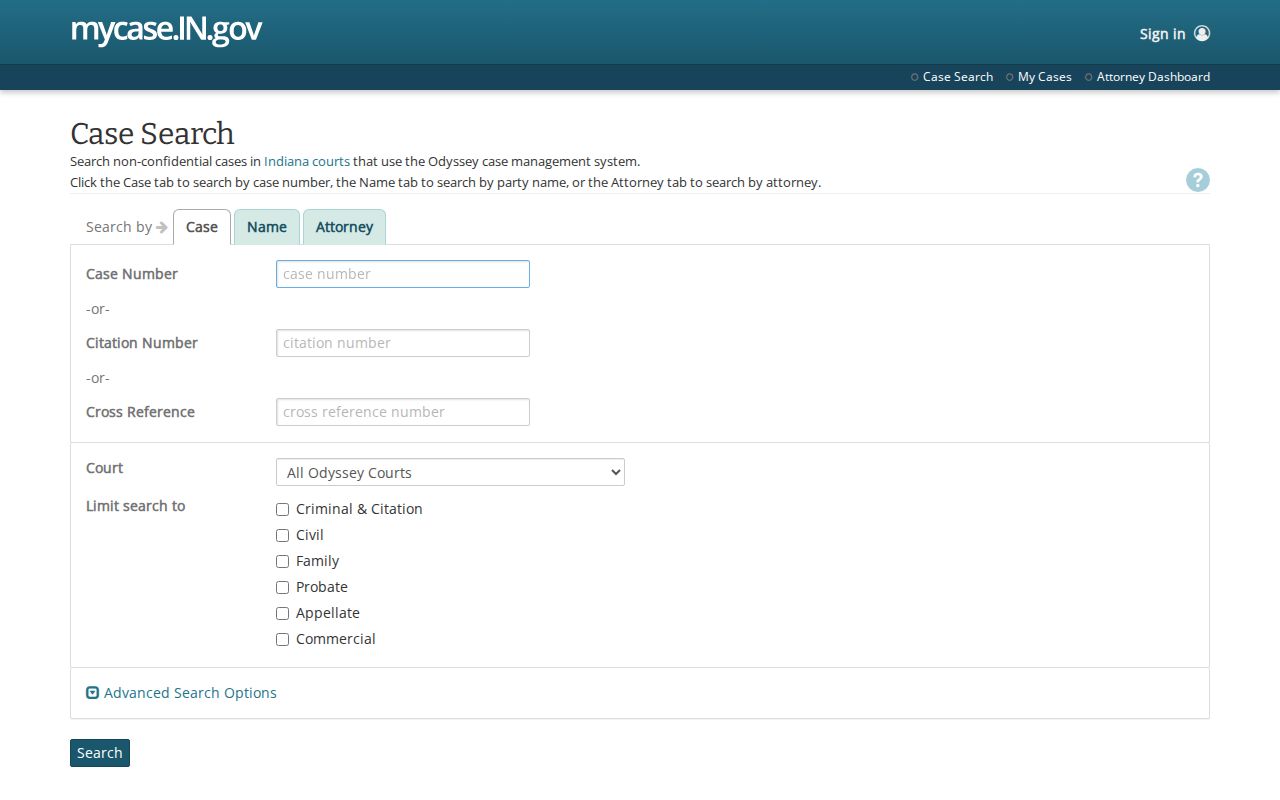
MyCase links an arrest to later court proceedings. Confirming the warrant itself still belongs to the office that issued it.
What Follows a Rush County Arrest
Booking is only the start. Bond may be set. An initial hearing follows, and the prosecutor decides which charges move forward. A booking charge can be amended, reduced, dismissed, or resolved by plea or trial. The Rush County Clerk and MyCase carry the cause number, public hearings, filings, and final outcome. Some case types stay nonpublic under Indiana court rules. A docket can also lag a fresh booking. Match a case by more than a name whenever official identifiers exist, and never fill a gap with a guess.
The court record is what shows how a Rush County case ended. The docket, not the booking charge, gives that answer.
Booking dates and publication dates are different things. A clear Rush County example shows why. A Recorder report dated July 29 carried booking dates ranging from July 15 through July 27. Other reports mix intake dates the same way. A story's date is never the arrest date, so note the date each source actually displays.
State, Federal, and Immigration Custody
Custody does not always stay at Rush County Jail. When it moves, the right locator changes too. IDOC covers people in Indiana state correctional custody and searches by name or DOC number. Its offender-records office runs an Authorization for Release process for material outside the public locator. A county booking is not a prison placement.
The Federal Bureau of Prisons locator handles federal prisoners but shows no booking photos. The ICE Online Detainee Locator covers some immigration custody through an A-number or biographical details. The Marshals Service offers no county booking search. None replaces JailTracker for a fresh arrest.
Indiana SAVIN/VINE is a separate notification service. It sends release and transfer alerts for covered custody. It is not a guaranteed instant booking feed. Confirm the person through Rush County first. Then follow the VINELink Check instructions for one-person searching and alerts.
This staging explains why one name appears in one system and not another. Just booked means the county roster may still be catching up, and in custody means the live roster should show an entry. After release the live entry disappears while the booking and court records remain, and a state or federal sentence calls for the matching locator.